Gordon Parks was a photographer, writer, filmmaker, and composer whose work shaped the visual and cultural record of 20th-century America. He used his camera—and later film, music, and writing—not just to document life, but to confront racism, poverty, and social injustice, always insisting on the dignity of his subjects. Parks called the camera his “choice of weapons,” a tool for demanding change.
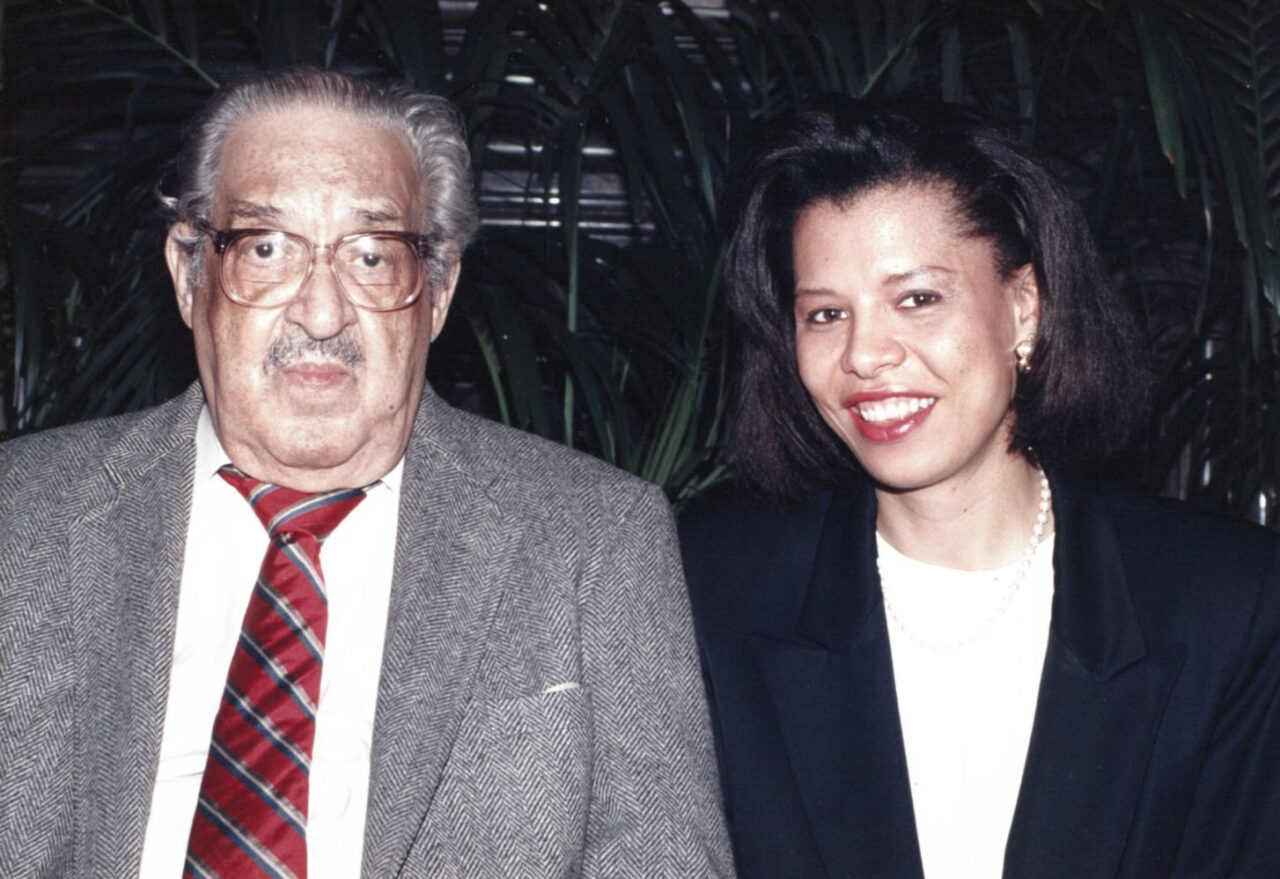
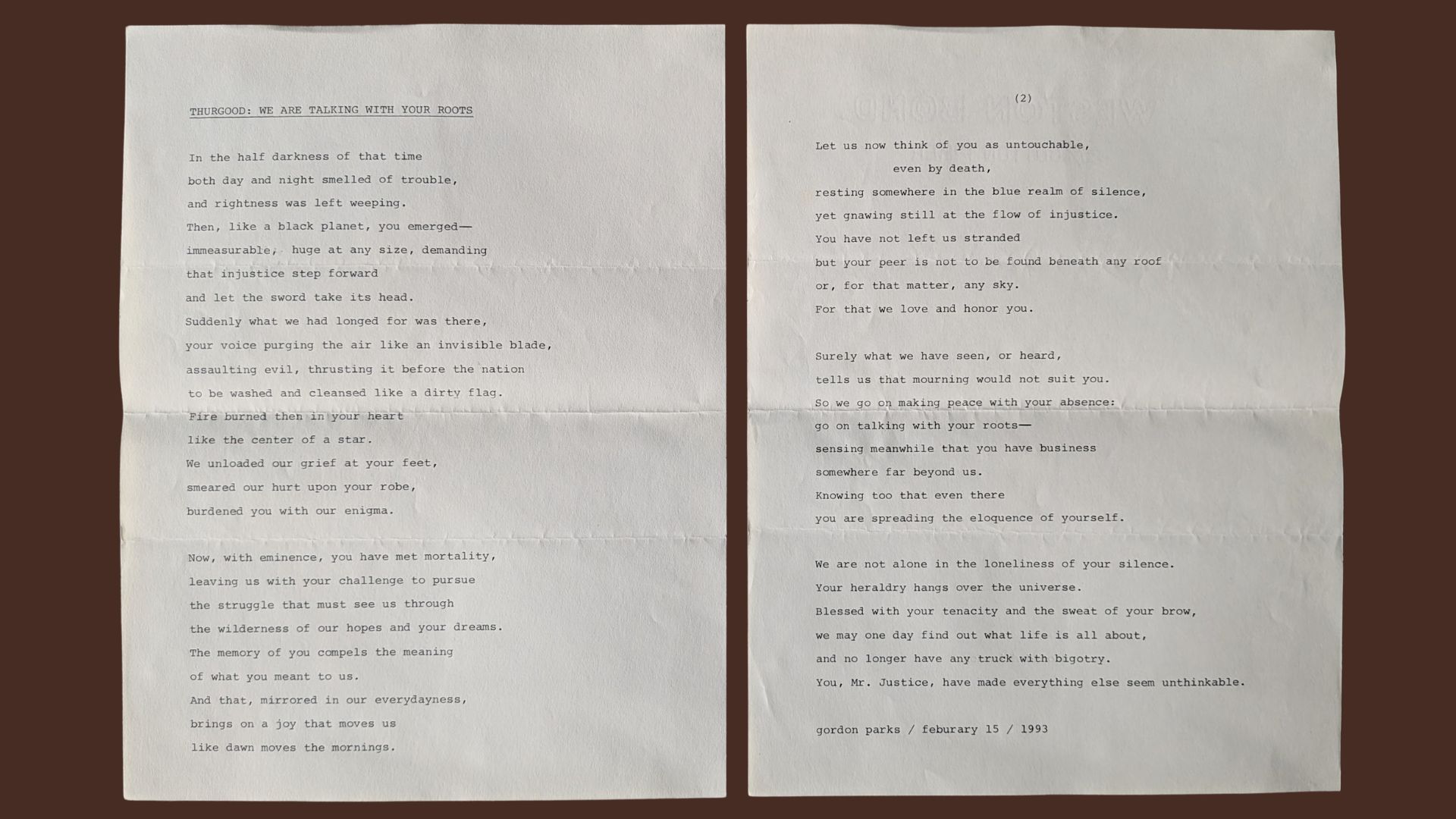
Late in life, Parks wrote the poem “Thurgood: We are Talking with Your Roots” to honor Thurgood Marshall. The poem celebrates Marshall as a force that uncovered injustice and insisted it be seen. Parks saw his own work the same way: inviting viewers to look, then confront the truths before them.
Like Marshall, Parks spent decades making visible lives shaped by systemic inequities—segregated families, children in poverty, communities often overlooked. Both demanded, to use Parks’s words, that “injustice step forward,” compelling the nation to face its consequences. Parks presents Marshall not only as a figure to admire, but as a model of courage and integrity, a reminder of what commitment to justice looks like in practice.
Park’s poem does not present justice as resolved, nor legacy as closure. Marshall, Parks writes, is still “gnawing at the flow of injustice.” The work continues, and it falls to those who refuse to look away.
THURGOOD: WE ARE TALKING WITH YOUR ROOTS
In the half darkness of that time
both day and night smelled of trouble,
and rightness was left weeping.
Then, like a black planet, you emerged —
immeasurable, huge at any size, demanding
that injustice step forward
and let the sword take its head.
Suddenly what we had longed for was there,
your voice purging the air like an invisible blade,
assaulting evil, thrusting it before the nation
to be washed and cleaned like a dirty flag.
Fire burned then in your heart
like the center of a star.
We unloaded our grief at your feet,
smeared our hurt upon your robe,
burdened you with our enigma.
Now, with eminence, you have met mortality,
leaving us with your challenge to pursue
the struggle that must see us through
the wilderness of our hopes and your dreams.
The memory of you compels the meaning
of what you meant to us.
And that, mirrored in our everydayness,
brings on a joy that moves us
like dawn moves the mornings.
Let us now think of you as untouchable,
even by death,
resting somewhere in the blue realm of silence,
yet gnawing still at the flow of injustice.
You have not left us stranded
but your peer is not to be found beneath any roof
or, for that matter, any sky.
For what we love and honor you.
Surely what we have seen, or heard,
tells us that mourning would not suit you.
So we go on making peace with your absence:
go on talking with your roots—
sensing meanwhile that you have business
somewhere far beyond us.
Knowing too that even there
you are spreading the eloquence of yourself.
We are not alone in the loneliness of your silence.
Your heraldry hangs over the universe.
Blessed with your tenacity and the sweat of your brow,
we may one day find out what life is all about,
and no longer have any truck with bigotry.
You, Mr. Justice, have made everything else seem unthinkable.
gordon parks / february 15 / 1993
Gordon Parks (American, 1912–2006)
In a career that spanned more than fifty years, photographer, filmmaker, musician, and author Gordon Parks created a groundbreaking body of work that made him one of the most influential artists of the twentieth century. Beginning in the 1940s, he documented American life and culture with a focus on social justice, race relations, the civil rights movement, and the African American experience. Born into poverty and segregation in Fort Scott, Kansas, Parks was drawn to photography as a young man. Despite his lack of professional training, he won a Julius Rosenwald Fellowship in 1942; this led to a position with the photography section of the Farm Security Administration (FSA) in Washington, D.C., and, later, the Office of War Information (OWI). By the mid-1940s, he was working as a freelance photographer for publications such as Vogue, Glamour, and Ebony. Parks was hired in 1948 as a staff photographer for Life magazine, where more than two decades he created some of his most notable work. In 1969 he became the first African American to write and direct a major feature film, The Learning Tree, based on his semiautobiographical novel. His next directorial endeavor, Shaft (1971) helped define a genre then referred to as Blaxploitation films. Parks continued photographing, publishing, and composing until his death in 2006.