Thank you Mr. Jones. Good morning.
I first want to thank our veterans and those actively serving in our Armed Forces. To the families of our veterans and active duty service members: your sacrifice is immense. You are in my prayers, especially during these challenging times. May we also give quiet gratitude to those who paid the greatest price for our nation.
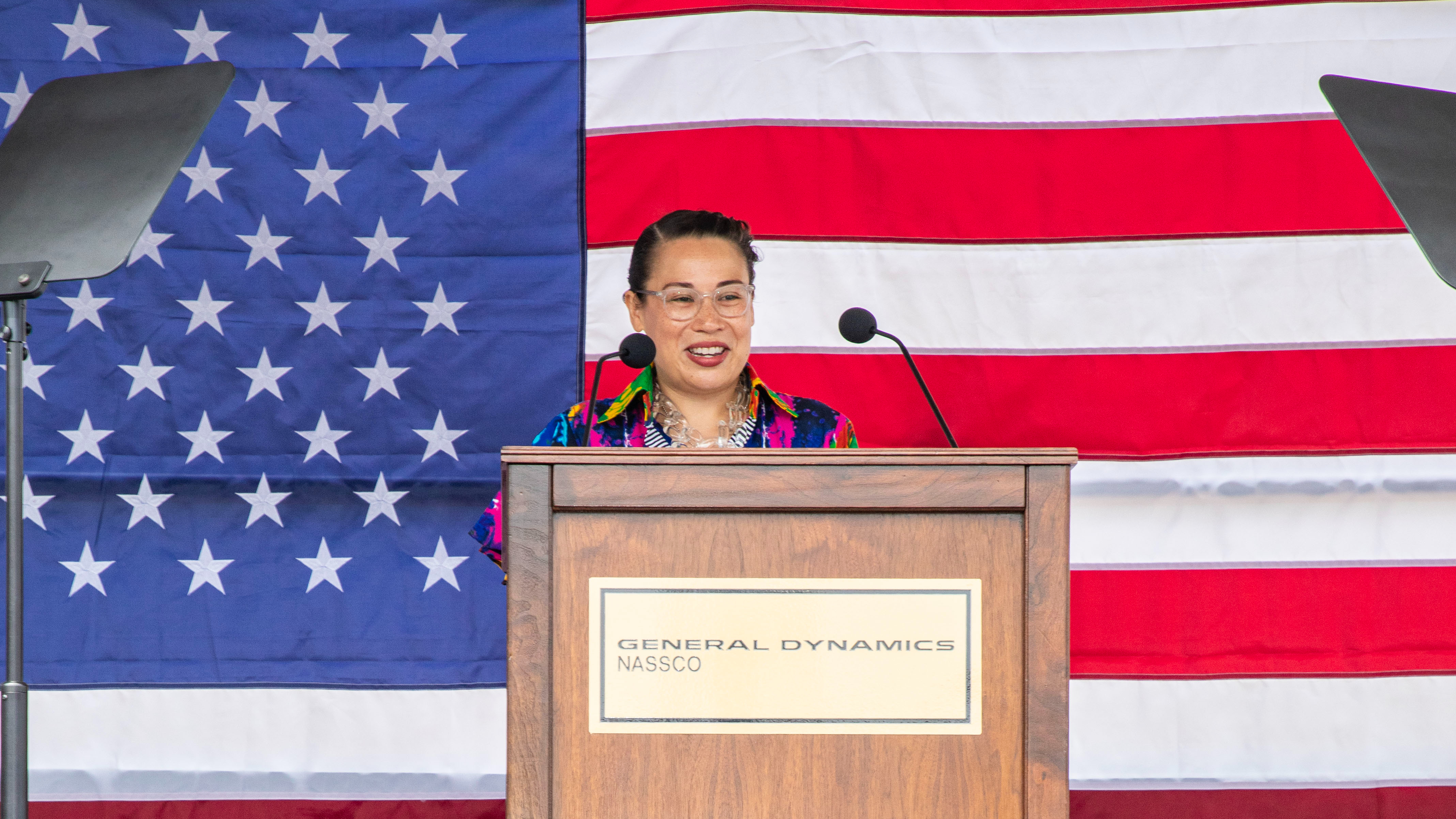
On behalf of the entire Thurgood Marshall family, thank you to everyone here today to support the christening of the USNS Thurgood Marshall. Thank you to the United States Navy for this honor, and to Secretary Del Toro who is with us today for selecting Alissa, Melonie, and me as sponsors. Thank you as well to all the shipbuilders whose labor brought this vessel to life.
My grandfather founded the NAACP Legal Defense Fund 86 years ago, an organization I serve on the board of directors of is still on the frontlines of justice today. Most recently, our President and Director-Counsel Janai Nelson argued Louisiana v. Callais before the United States Supreme Court. We are also honored to have former Director-Counsel Ms. Elaine Jones with us today.
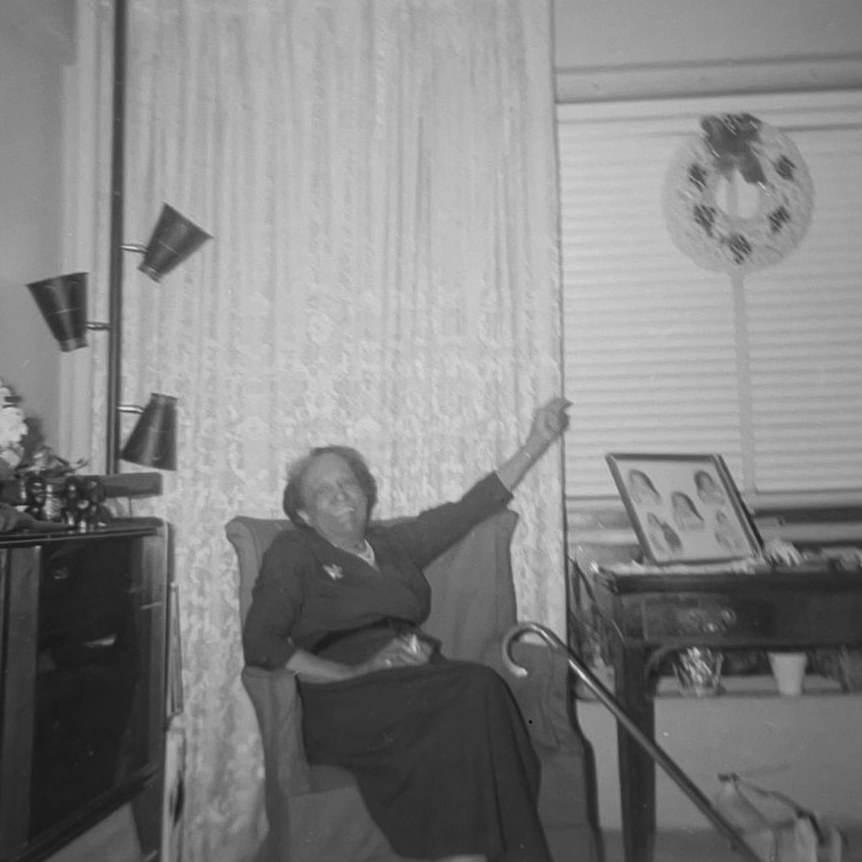
When I think of my grandfather, I think of childhood weekends at my grandparents’ house, just being with Grandpa and Grandma, whose name I carry. I was eleven when he passed. I didn’t understand death, and I didn’t yet understand his legacy. I just knew I was sad he was gone.
What followed was a series of formal events that felt like slow motion. It was a cold January. I stood in the Great Hall of the Supreme Court, dressed in my finest, next to his casket, watching thousands of people file past to pay their respects. Grandmothers, mothers, their children, quietly honoring him. I struggled to understand why people who weren’t family would wait for hours just to be there.
As I grew up and learned his legacy, I understood. After my grandmother’s passing, it became my duty to share him with the world. That means sharing the stories of his clients, the people he saw as heroes, and firsthand accounts from those who knew him, preserving his journey so we can inspire the next generation of Thurgoods. Through the Thurgood Marshall Foundation we are bringing that journey directly to communities across the country with a traveling museum, a tractor trailer that will carry his story across the nation.
My grandfather received the Liberty Medal in July of 1992 and, this was one of his last public speeches, he didn’t speak of his victories, he spoke of his clients, his frustrations of where America was, he challenged us, and he inspired us. He started by saying:
“I’d like to share a few stories, a few anecdotes, of people who have understood the meaning of liberty and struggled against the odds to become free. I think of these people because of the risks they have taken and the courage they have displayed. I value them not only because of the people they are but because of the kind of nation they insisted that we become. I respect them not because of the influence they wielded but because of the power they seized. It is useful, I think, to recall their stories not to dwell on the past, but to see concrete evidence of what was in order to gain inspiration for what can be.”
I’d like to do the same. As we come together here in San Diego on this 6th day of June, the 82nd anniversary of D-Day, one such story of courage that has been forgotten in the history books is Staff Sargent Waverly Woodson Jr. He attended the same university as my grandfather, Lincoln University, an HBCU in Pennsylvania. He showed the courage to volunteer and leave his pre-med program early to serve during World War II. Among the thousands who stormed Omaha Beach on that June morning, Woodson’s path there had already been marked by both determination and injustice. He passed a rigorous exam to earn a spot in Anti-Artillery Officer Candidate School, only to finish training and find the door closed. There were no positions open to Black officers. So the Army made him a medic instead, assigning him to the 320th Barrage Balloon Battalion. And on June 6th, 1944, he arrived at Omaha Beach already wounded, hit by shrapnel before he ever reached the shore. But for the next 30 hours, with his own injuries, he treated more than 200 of his fellow soldiers. He was nominated for the Medal of Honor that very summer. He never received it. Not a single one of the million-plus Black personnel who served in World War II received one of the 432 Medals of Honor awarded during the war.
Woodson’s story was not an exception — it was the rule. Despite extraordinary acts of valor, Black soldiers were systematically denied what they deserved.
It was precisely this kind of racial injustice that my grandfather made it his life’s mission to dismantle. That same summer of 1944, just weeks after Woodson was treating the wounded on Omaha Beach, an explosion at Port Chicago, California killed 202 Black soldiers who had been ordered to load live munitions. When 50 Black sailors refused to return to that same dangerous work and were charged with mutiny, my grandfather was sent to observe what became the largest court martial in U.S. history. He spent two weeks interviewing the men, reviewing the evidence, and when the Navy delivered guilty verdicts after deliberating just 45 minutes, he went directly to the Secretary of the Navy and fought until those men received reduced sentences, returns to active duty, and honorable discharges. Eighty years later Secretary Del Toro exonerated those sailors. The pattern was undeniable: Black men were good enough to die for this country, but not good enough to be treated equally within it. When word reached him that Black soldiers in Korea were being court-martialed at rates wildly disproportionate to their white counterparts, he got on a plane and flew into a war zone. What he found was not justice, but theater,trials in the middle of the night, life sentences handed down in hearings that lasted less than ten minutes, men convicted of cowardice while witnesses testified they were lying in a hospital bed. When my grandfather returned home, he reported that what happened in Korea was an old story, as old as Jim Crow in the armed services, the sacrifice of Black troops upon the altar of segregation. And he did all of this while simultaneously building, brick by brick, the most consequential civil rights case in American history — Brown v. Board of Education — proving that the same nation that sent Black people to die for democracy abroad had no intention of extending it to them at home, unless people like my grandfather forced it to.
But what is easy to lose in the ledger of cases and courtrooms is what Thurgood Marshall meant to ordinary people. When Black soldiers were railroaded thousands of miles from home, their families didn’t lose hope — they picked up a pen and wrote a letter. To the NAACP. To my grandfather. Because word had spread, from courthouse steps to church pews, from barbershops to front porches, that there was a man who would come. Who would show up. Who would look the most powerful in the eye and refuse to back down. Communities didn’t just hope for justice in the abstract — they hoped for him, specifically. And when he got on that plane to Korea, when he walked into that Navy courtroom at Port Chicago, when he filed that brief that would eventually reach the Supreme Court, the people who had been waiting knew something had shifted. Because Thurgood was coming. And when Thurgood came, the fight wasn’t over, but it was no longer theirs to carry alone.
History is only as alive as the people who carry it. And the people who knew my grandfather, who sat beside him, who watched him fight, left us something valuable, they left us their witness.
Congressman John Lewis, in whose honor this oiler fleet is named, remembered the first time he encountered him as a young man in Nashville. He said:
“Thurgood was a very warm, humane, and humorous person… To hear him and see him during my days in Nashville come to a little church or the Fisk University gym was an inspiration. I grew up hearing about Thurgood Marshall, and the first time I met him was like meeting a legal savior.”
Jack Greenberg, who succeeded my grandfather at the Legal Defense Fund, said
“He was earthy and bright. He related to people, not abstract theories.”
Attorney Juanita Jackson Mitchell, the first African-American woman to practice law in Maryland and organizer with the NAACP said:
“Thurgood Marshall was the legal conscience for all Americans, not just Black Americans.”
Vernon Jordan said:
“Thurgood Marshall was more than a crusader for justice, more than a torch-bearer for liberty, he was a teacher who taught us to believe in the shield of justice and the sword of truth”
Justice Elena Kagan, who clerked for my grandfather said
“He was the greatest lawyer in the twentieth century…He had an ability to get to the heart of a problem, to see straight through to what was most important in any legal issue, and he kept his eyes on the prize for his entire career to use that expression, he didn’t let himself be distracted, he had a strategy for how he wanted to go about fighting the fight for racial equality”
My grandfather spent his entire life fighting for a true democracy. Today, as we christen this vessel in his name, we are not simply honoring a man. We are making a declaration — that his work mattered, that the people he fought for matter. I will close with another quote from my grandfather’s speech in 1992:
“We must dissent from the poverty of vision and the absence of moral leadership. We must dissent because America can do better, because America has no choice to do better. The legal system can force open doors and sometimes even know down walls. But it cannot build bridges. That job belongs to you and me. We can run from each other but we cannot escape each other. We will only attain freedom if we learn to appreciate what is different and muster the courage to discover what is fundamentally the same. America’s diversity offers so much richness and opportunity. Take a chance, won’t you? Knock down the fences that divide and tear apart the walls that imprison. Reach out; Freedom lies just on the other side.”